A 2027 revenue plan comes down to four numbers: how many opportunities you create, how big the average deal is, how often you win, and how long a deal takes to close. Most of the plans I’ve reviewed this fall ask all four to get better at the same time.
One example: rep productivity going from the low 60s percent of quota to around 90, average deal size up 30 percent or more, win rates improving, and the team smaller after a headcount reduction. Each of those might be defensible on its own. I’m not sure anyone has looked at them stacked together.
The four levers
Sales velocity is the simplest way I know to keep those four honest. It’s opportunities times average selling price times win rate, divided by days to close.
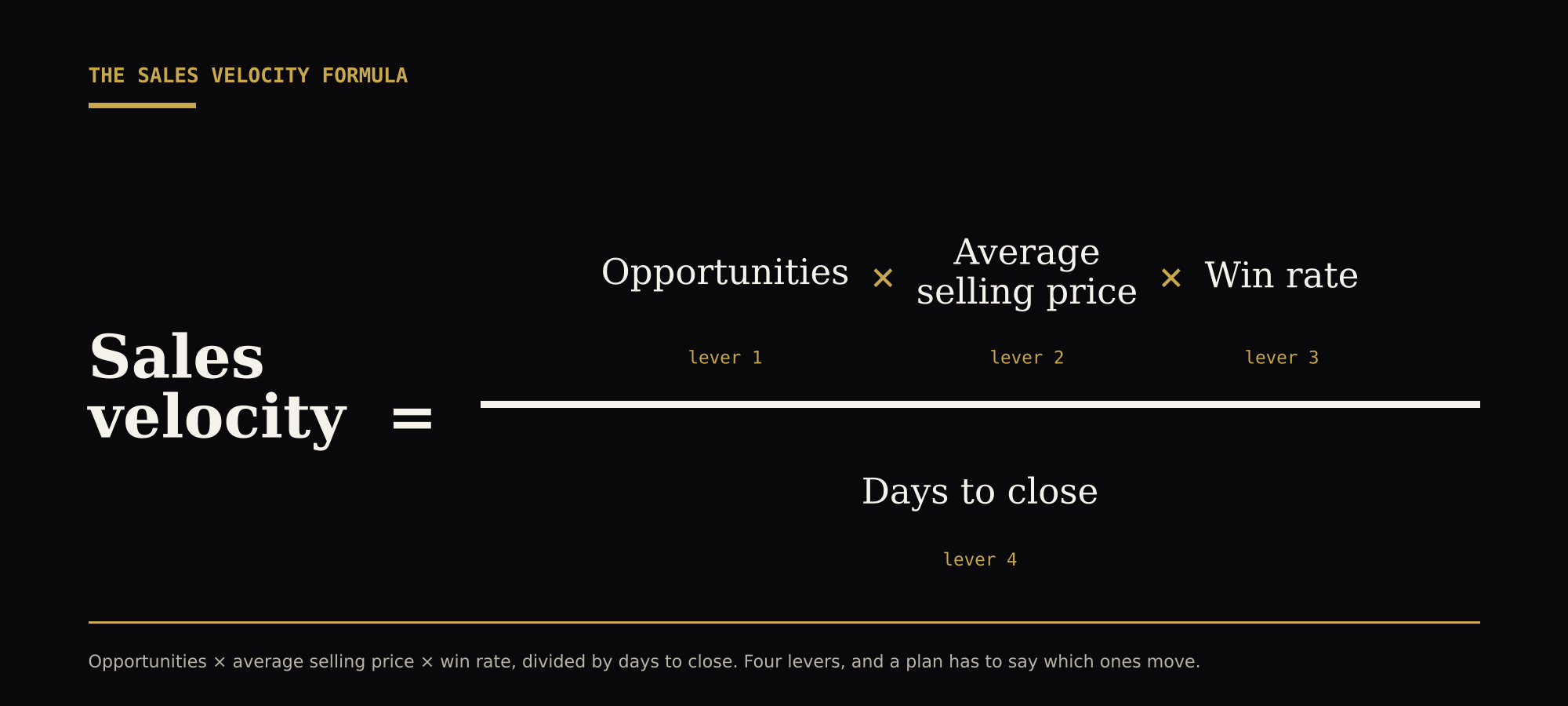
Revenue growth has to come from one of those four. If the plan says velocity goes up 40 percent next year, I’d ask which levers carry it and by how much. “A little from each” is usually how a plan gets written, and I don’t think it’s how a year actually goes.
Why stacked plans get through
Each assumption sits on its own row of the model and looks reasonable there. Rep productivity is justified by a new enablement leader, deal size by a move upmarket, win rate by better qualification. Nobody is asked what happens if two of the three come in flat.
The reorg makes it harder to see. A headcount reduction, a new sales leader and a go-to-market reset often land in the same year, and each one costs a quarter or two of productivity before it pays back. I don’t think most of the plans I’ve seen account for that dip.
What I’d do before the plan goes to the board
Calculate your sales velocity by quarter for the last two years. Find the lever that actually softened. That’s usually the one to fix first, and it’s often not the one the plan is counting on.
Pick one or two levers to carry the plan and hold the rest flat. If win rate is the lever you believe in, keep deal size and cycle length at last year’s level in the model.
Ramp productivity by quarter instead of applying the full-year number from January. Something like 70 percent in Q1, stepping up to around 90 by the end of the year, gives the go-to-market changes time to show up in pipeline.
Tell the board which assumptions you’re least sure about, and keep a gap between the board plan and the field plan. The board number is what you commit to. The field number is what you ask the team to run against.
