The Refounding
VELOCITY SUMMIT RECAP: What one CEO’s full-scale product reinvention reveals about the architectural mandate facing every venture-backed company right now.
A two-time founder. A scaled SaaS company. An AI moment that made his existing product look slow, expensive, and wrong.
He didn’t panic. He started over.
That story — told publicly for the first time at our recent Velocity Summit — was the most important thing that happened in the room. Not because the product is finished (it launches this summer). Not because the playbook was clean. He called it a reckoning, not a success. That distinction matters more than most leaders want to admit.
Here’s what he actually did.
The First Move That Failed
His instinct was the same one most CEOs reach for: mandate AI adoption across engineering. Set a deadline. Ask for reports. The reports came back green. Nothing changed.
Engineers resisted because being a developer is an identity built over the years. You cannot mandate your way through that. This is not a motivation problem. It’s an architectural one. So he went around it entirely.
He selected three people from outside engineering — deep experts in the product and the customer, curious about AI, not coders. He gave them NDAs — not for legal protection, but to insulate the work from organizational politics, give the team permission to fail, and rebuild without the inherited weight of how the current product worked.
The Design Principles
Three rules governed the rebuild: Fix what was broken. Build what customers had been asking for for years. Don’t try to catch up to the market — leapfrog it. They didn’t look at the existing product. They rethought it from zero, including designing for AI agents as the primary user, not humans.
“The person who should have initiated this was product, not engineering. If no one on your team is thinking about reinvention right now, that’s a product leadership gap.”
When the new platform was revealed at the company kickoff, the CS and support teams — who had spent years watching customer requests go unaddressed — reacted viscerally. Engineering, seeing that reaction, had nothing left to object to.
The Constraint Is Gone
This story landed hard in our network, not because it’s exceptional, but because almost every CEO in the room recognized themselves in it.
They’re further behind than they think. The product they ship today was designed for a world where knowledge work was slow and expensive. That world ended.
Expert knowledge work used to take weeks. It takes minutes now. It used to require a team of specialists. One skilled AI architect should outperform that team. The operating model most companies run was built around constraints that no longer exist.
The Org Structure That’s Coming
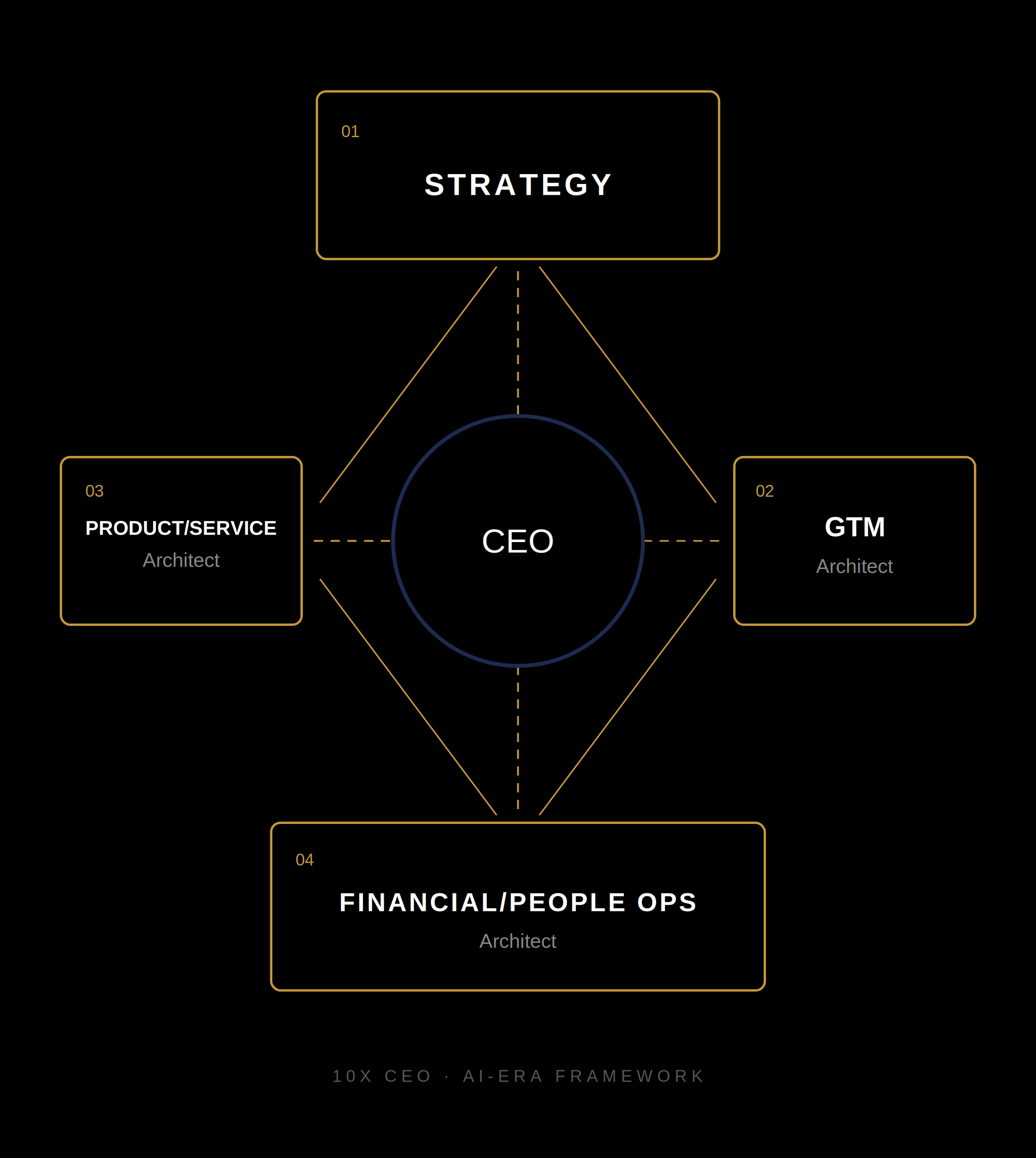
The structural implication: future companies organize around work centers — Product, Go-to-Market, and Finance/People Ops — each led by an Architect. The CEO sits at the center, driving strategy, with three direct reports to orchestrate rather than manage. Titles will still exist — you need them to hire. But they won’t describe the job anymore.
→ Watch the highlight reel from Velocity
What We Heard Across Every Breakout Room
Personal CEO AI adoption is high. Team adoption is not. The gap between individual use and organizational adoption is the most common failure mode we’re seeing across the network right now.
GTM is the biggest blind spot. The network is furthest behind on applying AI to go-to-market.
Org design is a trailing indicator. Behavior shifts first. Structure follows. Don’t wait for the org chart to tell you what’s changing.
MCP is being underestimated. Most CEOs haven’t fully internalized what agent-to-software interaction means for their operating model. This is the next unlock.
Almost every CEO left asking the same question:
If a well-funded competitor started building our product from scratch today — no legacy constraints, AI-native from day one — what would they build? Is there a version of us that builds it first?
Your 4-Step AI Transformation Plan
The window to build architectural advantage is narrower than most CEOs think. The CEOs moving fastest aren’t running pilots or forming task forces. They’re making structural commitments. Here’s how to move.
Step 1 — Model AI-Native Behavior Personally
This doesn’t start with your team. It starts with you. The CEOs who are moving fastest have made AI part of how they personally do their highest-leverage work — strategy, decision-making, prep, analysis. Not as a productivity tool. As a thinking partner. Your team will follow what you demonstrate, not what you mandate.
Step 2 — Envision the Flattened Exec Team
Draw the org you’re moving toward: CEO at the center, three Architect-level leaders running Go-to-Market, Product/Service, and Finance/People/Ops. Each is accountable for outcomes, not functions. Each capable of designing AI-powered workflows that didn’t require a team of specialists last year. The question isn’t whether you get there — it’s how fast you can get there.
Step 3 — Run a Revenue-Per-Head Trajectory Analysis
Pull your revenue-per-head number today. Model what it needs to look like in 24 months if you’re going to compete with an AI-native company building in your space right now. The gap between those two numbers is your architectural mandate — the specific, quantified case for rebuilding your operating model. Most CEOs haven’t done this math. Do it before your next board meeting.
Step 4 — Audit Your Org Chart Against the AI Question
Go function by function. For each one, ask a single question: Can AI do this better, faster, and at scale? If the answer is yes, you don’t have a people problem — you have an architectural opportunity. The audit will tell you what to rebuild, and in what order. Start with the function where the gap between current performance and AI-possible performance is largest. That’s almost always GTM.
The Commitment
These four steps aren’t a project plan. They’re a posture shift. The CEOs who move on this now will compound that advantage every quarter. The ones who wait will find themselves catching up to competitors who didn’t.
Write down one leadership behavior or decision you will change. Not a goal. Not an initiative. One thing you will do differently starting this week.
The 10X CEO network exists for CEOs who are already thinking at this level and want a room full of peers doing the same.